
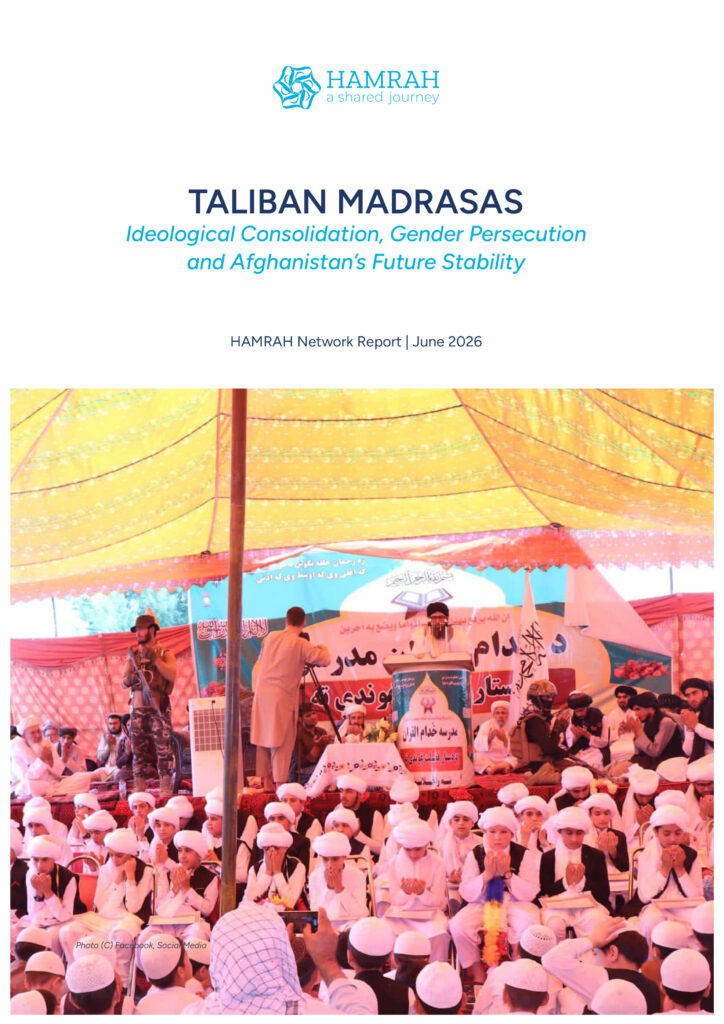
In less than four years, the Taliban have built a parallel religious education system that now exceedsAfghanistan’s public schools in scale. This reflects a deliberate shift towards a well-resourced and centrally administered state religious education system, designed to subordinate modern public education under a politicised ideological framework.
HAMRAH Network’s new report, Taliban Madrasas: Ideological Consolidation, Gender Persecution and Afghanistan’s Future Stability, is the product of sensitive fieldwork and discreet data collection conducted inside Afghanistan between March and May 2026, with a focus on Kandahar and Bamiyan provinces. It documents what is happening on the ground, why it matters, and what must change.
The findings are stark.
Religious education institutions now outnumber public schools across Afghanistan. By September 2025, the Taliban’s de facto Ministry of Education reported over 23,000 registered madrasas, with more than 3.65 million students enrolled. These institutions, including jihadi madrasas, now shape every level of Afghan society. The Taliban have established 92 madrasas inside prisons and enrolled 9,000 orphans into the system.
The madrasa system has become the primary infrastructure through which Taliban gender persecution is being institutionalised, modern education being hollowed out. Girls banned from secondary education are being channelled into female madrasas as their only option. Boys are being taught that loyalty to the Emirate supersedes family bonds and are being encouraged to report on their own households.
The security implications extend well beyond Afghanistan’s borders. The cross-border madrasa ecosystem linking the Taliban and the Tehrik-i-Taliban Pakistan is already fuelling regional instability. Pakistan declared a state of “open war” with Afghanistan in February 2026. The institutional infrastructure for wider violence is now firmly in place.
Yet current international responses neither recognise the scale of this structural transformation nor adequately address its risks. Engagement strategies premised on the hope that governance responsibilities would moderate Taliban behaviour have produced no evidence of change. Failure to reposition that engagement is, in effect, legitimising the Taliban’s project.
The report sets out clear, practical recommendations for governments, international organisations, regional actors, and donors. It explains how they can respond, and why the window for effective action is rapidly narrowing.
Read and download the full report.


